North Carolina's Closed Crawl Space Rules, Read for Raleigh Homeowners
North Carolina's residential code has a section written for sealed crawl spaces, and the state fire marshal's office has answered several questions about it. Here is what it says, in plain terms, for anyone weighing a conversion.
Section R409 of the North Carolina Residential Code defines a closed crawl space: a ground vapor retarder of at least 6 mil, a floor that drains to low spots, and one of five mechanical drying methods. The NC Office of State Fire Marshal said in December 2025 that converting a vented crawl space to a closed one needs a permit regardless of cost.
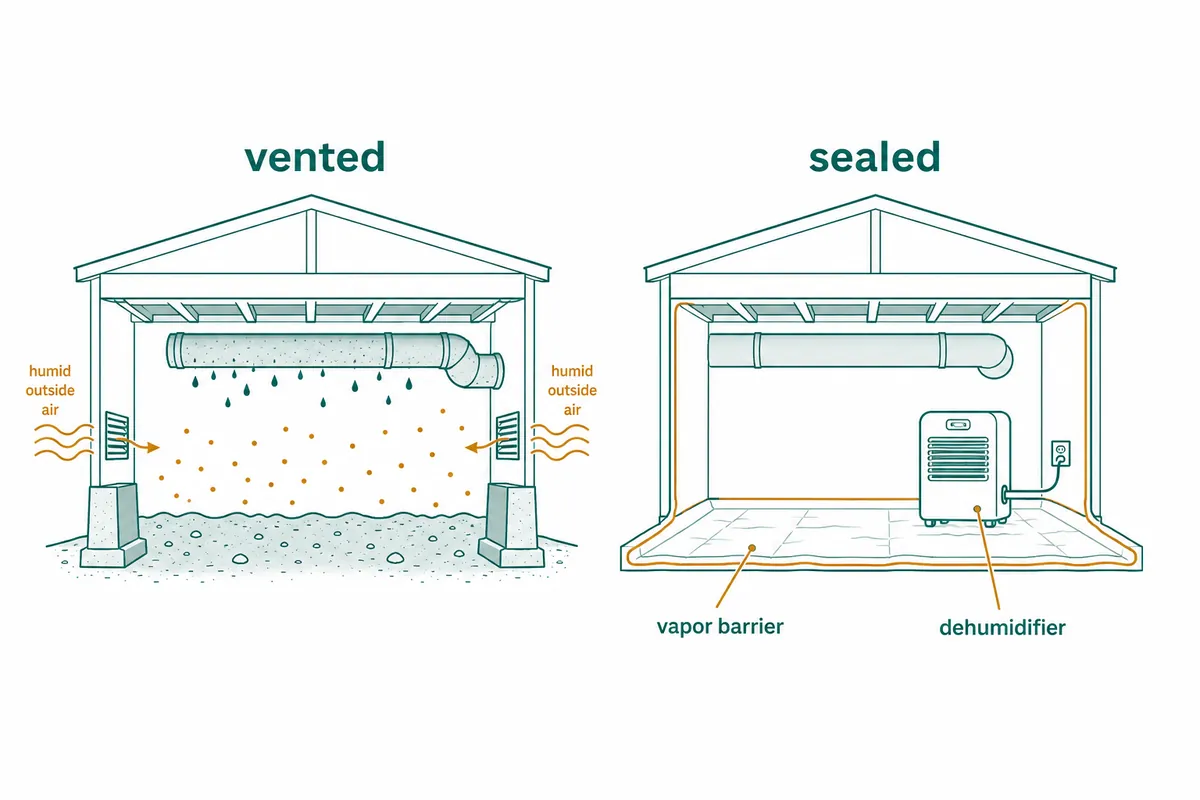
The ground and the drains
The 2018 code text quoted by the fire marshal's office says closed crawl spaces must be protected from water evaporating off the ground. That means polyethylene of at least 6 mil, or an equivalent, nominally covering all exposed earth, with joints lapped at least 12 inches. Small wrinkles are allowed. The floor has to be graded so it drains to one or more low spots, each with a drain to daylight or a sump pump, and those drains must stay separate from gutter drains and foundation perimeter drains.
What drying methods does the closed crawl space code allow?
- Dehumidifier: permanently installed, with a condensate pump or drain and an electrical outlet.
- Supply air: ducted in from the home's air conditioning system.
- House air: blown into the crawl space with a fan.
- Exhaust fan: crawl space air pushed outdoors by a fan.
- Conditioned space: the crawl space designed as part of the heated and cooled house.
A 2019 fire marshal interpretation, relaying the plumbing and heating licensing board, says supply air and conditioned space need an H-3 heating license, while the other three do not. Our crawl space dehumidifier page covers the most common choice.
Does a closed crawl space conversion need a permit?
North Carolina law usually exempts work on a single-family home from a building permit when it costs $40,000 or less, but not when the work adds or changes heating, air conditioning or electrical equipment (G.S. 143-138(b5) and 160D-1110(c)). Each of the five drying methods does exactly that, so the fire marshal's office concluded in December 2025 that converting a vented crawl space to a closed one needs a permit regardless of cost.
Liners, walls and termites
A liner may be sealed to the walls and columns, but on masonry walls it has to stop 3 inches below the top, leaving a 3- to 4-inch inspection gap under the wood sill. In April 2026 the fire marshal's office confirmed that carrying the plastic up the walls is allowed, not required. The vapor barrier and liner page explains the trade-offs, and the permit line and other typical costs show where the money goes.
Sources
- NC Office of State Fire Marshal: liner on closed crawl space walls (Apr. 16, 2026)
- NC Office of State Fire Marshal: closed crawl space moisture control, permitting and H-3 licensure (2019)
- NC Office of State Fire Marshal: permit required for a closed crawl space (Dec. 11, 2025)
- N.C. Gen. Stat. 143-138, North Carolina State Building Code
- N.C. Gen. Stat. 160D-1110, building permits
What's going on under your floor?
Tick the closest match and add a sentence about what you've noticed: a smell, sagging insulation, water after storms. A crawl space specialist who works in Raleigh phones you to go over it.